


The Philosophy of Infinite Growth
In the world of home gardening, the most satisfying experience is not the harvest itself, but the cycle of renewal. Many beginner gardeners view harvest as a final act—the moment a plant is pulled from the soil, leaving an empty hole in the garden bed. However, experienced growers know the secret of the ‘perpetual harvest.’ By choosing specific crops and employing strategic cutting techniques, you can transform your garden into a self-sustaining pantry that provides fresh greens and herbs week after week without the need for constant reseeding.
Understanding the Biology of Regrowth
The ability of a plant to regrow after harvest relies on a biological process known as apical dominance and the presence of dormant axillary buds. When you cut the main stem of certain leafy greens or herbs, you are removing the primary growth tip. This sudden removal triggers the plant to redirect its energy, forcing it to push growth out through the secondary buds located lower down on the stem. If done correctly, the plant perceives this harvest as a pruning event rather than a terminal harvest, encouraging it to produce a fresh flush of foliage.
The Universal Rule: The Five-Centimeter Threshold
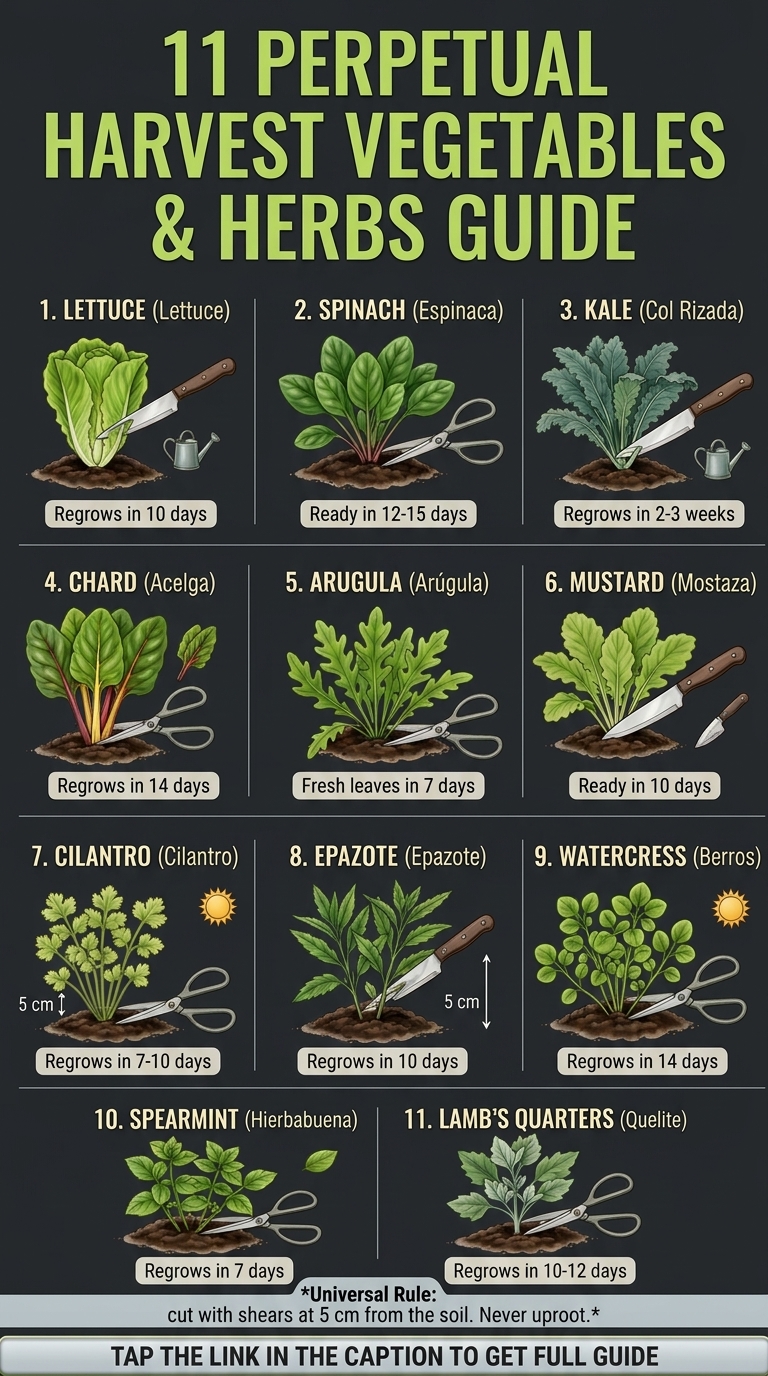
The most important lesson in perpetual harvesting is knowing exactly where to cut. If you trim too high, you only harvest a small amount of foliage. If you cut too low—specifically, if you cut into the woody base or the root crown—you risk killing the plant entirely. The golden rule for most cut-and-come-again crops is the five-centimeter threshold. By leaving at least five centimeters (roughly two inches) of stem above the soil line, you ensure that you are leaving behind enough active leaf nodes to fuel the photosynthesis required for regrowth. These remaining leaves act as the engine for the plant’s recovery.
Top Crops for Perpetual Harvesting
Not every plant behaves the same way when pruned. To get started with a perpetual garden, focus on these resilient varieties:
- Loose-leaf Lettuce: Unlike head lettuce, which is harvested all at once, loose-leaf varieties can be harvested by the outer leaves or sheared across the top.
- Swiss Chard: This nutrient-dense green is a powerhouse. By harvesting the outer stalks, you allow the center of the plant to continue pushing out new, tender growth indefinitely.
- Kale: Similar to chard, kale is a biennial that can thrive through several seasons if you harvest the outer, mature leaves first.
- Basil and Mint: These herbs thrive on regular pruning. Cutting just above a leaf node promotes bushier growth and prevents the plant from flowering prematurely.
- Arugula: Because it grows so rapidly, you can shear arugula back to the five-centimeter mark, and in many climates, it will offer three to four distinct harvests from one planting.
Practical Tips for Sustaining Your Harvest
To keep your plants productive throughout the season, follow these essential maintenance practices:
- Hydration is Key: Regrowth requires a significant amount of energy. Keep your soil consistently moist after a harvest to help the plant recover quickly.
- Supplemental Feeding: Since you are essentially asking your plants to grow twice as fast as normal, they will exhaust soil nutrients faster. Applying a gentle, organic liquid fertilizer after a major harvest can provide the necessary nitrogen boost to fuel new leaf production.
- Mind the Temperature: Many ‘cut-and-come-again’ greens are cool-weather crops. When temperatures climb too high, plants may ‘bolt’ or go to seed. When you see a central flower stalk forming, it is time to let the plant finish its cycle, as the leaves will often turn bitter.
- Use Clean Tools: Always use sharp, sterilized garden shears. Ragged cuts made by dull scissors can crush the stems, leaving the plant vulnerable to rot and pathogens. A clean, crisp cut allows the plant to heal its ‘wound’ quickly and focus on new growth.
By shifting your mindset from extraction to stewardship, you stop gardening for a single event and start gardening for a season of abundance. When you learn to respect the five-centimeter rule, your garden ceases to be a temporary project and becomes a reliable, living food source that sustains you long after the initial planting.